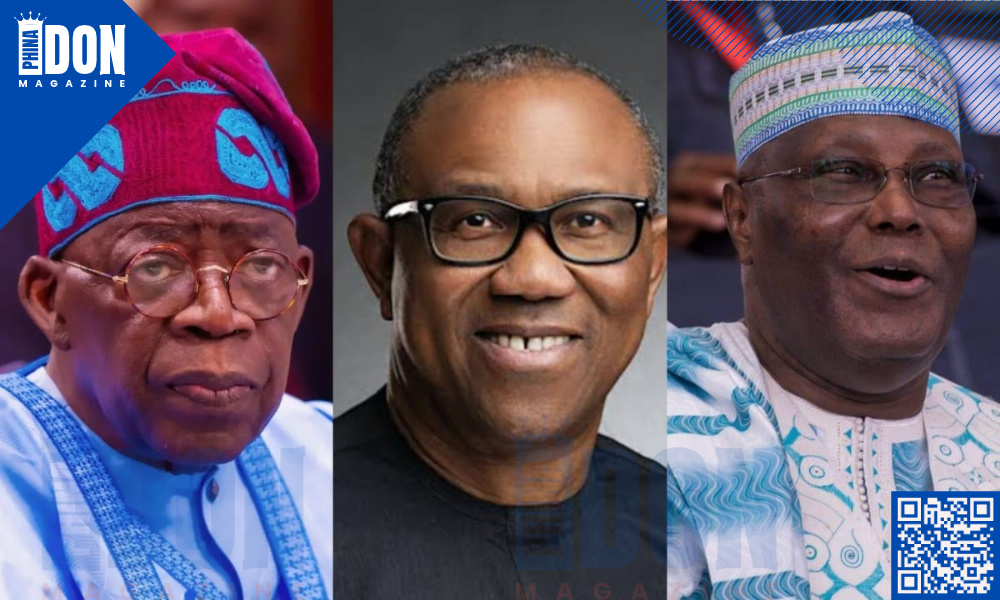
Fresh data from Nigeria’s controversial 2023 presidential election has reignited attention on the electoral performances of the major candidates, revealing how widely their support spread across the country. According to figures released by data analytics platform StatiSense, President Bola Ahmed Tinubu secured at least 25 per cent of the votes cast in 29 states, ahead of his major challengers, Atiku Abubakar and Peter Obi.
The figures, disclosed on Monday, offer another perspective on the geographical spread of votes during the election, which saw candidates of the All Progressives Congress (APC), Peoples Democratic Party (PDP) and Labour Party compete for the nation’s highest political office.
According to the breakdown, Atiku, who contested on the platform of the PDP, crossed the 25 per cent threshold in 21 states, while Peter Obi of the Labour Party achieved the same percentage in 15 states and the Federal Capital Territory (FCT). Rabiu Kwankwaso of the New Nigeria Peoples Party (NNPP), on the other hand, crossed the threshold in only Kano State.
HOW THE MAJOR CANDIDATES PERFORMED
Atiku recorded his strongest performance in Gombe State, where he secured 62.17 per cent of the votes, followed by Adamawa with 57.12 per cent and Yobe with 52.47 per cent. He also performed strongly in Kebbi, Bauchi, Sokoto, Osun and Katsina, among other states.
For Peter Obi, his strongest showing came from the South-East, particularly Anambra, where he polled an impressive 95.24 per cent, followed by Enugu with 93.91 per cent and Abia with 88.40 per cent. He also recorded significant percentages in Ebonyi, Imo, Edo, Lagos, Cross River and Plateau.
In the FCT, Obi secured 61.23 per cent of the votes, further adding to his geographical spread.
Meanwhile, Kwankwaso’s strongest and only qualifying performance was in Kano State, where he secured 58.59 per cent.
WHAT DOES THE 25 PER CENT REQUIREMENT MEAN?
Under Section 134(2)(b) of the Nigerian Constitution, a presidential candidate must secure at least one-quarter of the votes cast in each of at least two-thirds of all the states in the federation and the FCT, alongside obtaining the highest number of votes cast.
With Nigeria having 36 states, the constitutional requirement translates to at least 25 per cent of the votes in 24 states and the FCT.
Based on the StatiSense figures, Tinubu crossed the 25 per cent threshold in 29 states, five above the 24-state requirement. Atiku achieved the mark in 21 states, while Obi secured it in 15 states and the FCT. Kwankwaso met the threshold in Kano alone.
The FCT is counted separately because it is not constitutionally classified as a state.
A FRESH LOOK AT THE 2023 ELECTORAL MAP
The resurfaced figures provide an interesting picture of how votes were distributed across Nigeria during the 2023 presidential election. While Tinubu recorded the widest spread among the candidates in terms of states where he crossed the 25 per cent mark, Atiku and Obi also demonstrated considerable support across different parts of the country.
Beyond the numbers, the breakdown offers another opportunity to examine the geographical dynamics of the election and the voting patterns that shaped one of Nigeria’s most closely watched presidential contests.