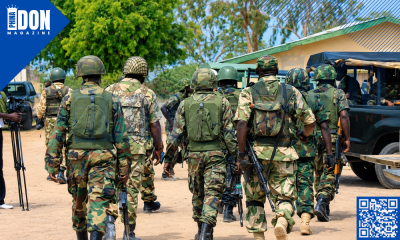
Former Chief of Defence Staff, General Lucky Irabor (Rtd), has stressed that Nigeria must develop adequate infrastructure if it is to fully harness technology in the fight against insecurity.
Irabor made the remarks during a Channels Television live programme, Generation Next: Youth, Power & The Future We Must Build, organised as part of activities marking Nigeria’s 66th Independence Day anniversary.
According to the retired general, Nigeria’s security challenges do not stem primarily from a lack of technological solutions. Rather, the central problem lies in the absence of the infrastructure and coordination required to deploy those solutions effectively.
He explained that no single technology could address the complexity of the threats confronting the country. Instead, various applications must be integrated within a broader system capable of collecting, processing and interpreting information.
“It is not about the non-availability of tech solutions or the non-application of tech solutions,” Irabor said. “No matter the technology that you have, there has to be an infrastructure within which you are to apply those tech solutions.”
He added that the integration of different technologies was essential to ensuring that they produced useful and actionable results. Without such coordination, individual systems could operate in isolation and fail to support effective decision-making.
Using drones as an example, Irabor noted that their usefulness in security operations extended beyond simply flying them over areas of interest. While drones can capture valuable images and information, their effectiveness depends on the availability of systems that can receive, transmit, analyse and distribute the data they collect.
He explained that drone footage could either be downloaded and analysed after the aircraft returned to base or transmitted in real time to an operations centre. Both options, he said, required reliable communication networks, data-processing facilities and other supporting infrastructure.
“There is an infrastructure that exists to make that possible,” he stated, noting that limitations in this area remained a significant challenge for Nigeria’s security agencies.
Despite the shortcomings, the former defence chief acknowledged that efforts were underway to address the infrastructure gap. He described the process as gradual, noting that improvements in the country’s security situation were partly linked to ongoing investments and reforms.
Irabor’s comments highlight the importance of adopting a comprehensive approach to security technology. Investments in drones, surveillance systems and other advanced tools must be accompanied by reliable digital networks, trained personnel, data-management systems and effective inter-agency cooperation.
For Nigeria to make meaningful progress in tackling insecurity, technology must therefore be viewed as part of a wider security ecosystem. Strengthening the infrastructure that supports innovation will be critical to ensuring that available solutions translate into timely intelligence, coordinated operations and improved protection for citizens.