Summary:
Nigeria pivots from raw exports to local processing with the launch of a new gold refinery in Lagos and a massive $600 million lithium facility in Nasarawa, marking a new era in the nation’s solid minerals sector under the value-addition policy.
The Nigerian mining landscape is undergoing a radical industrial transformation as the Federal Government officially confirms the operational kick-off of a high-purity gold refining plant in Lagos. This major development is accompanied by the announcement that a massive $600 million lithium processing plant in Nasarawa State is now completed and ready for commissioning.
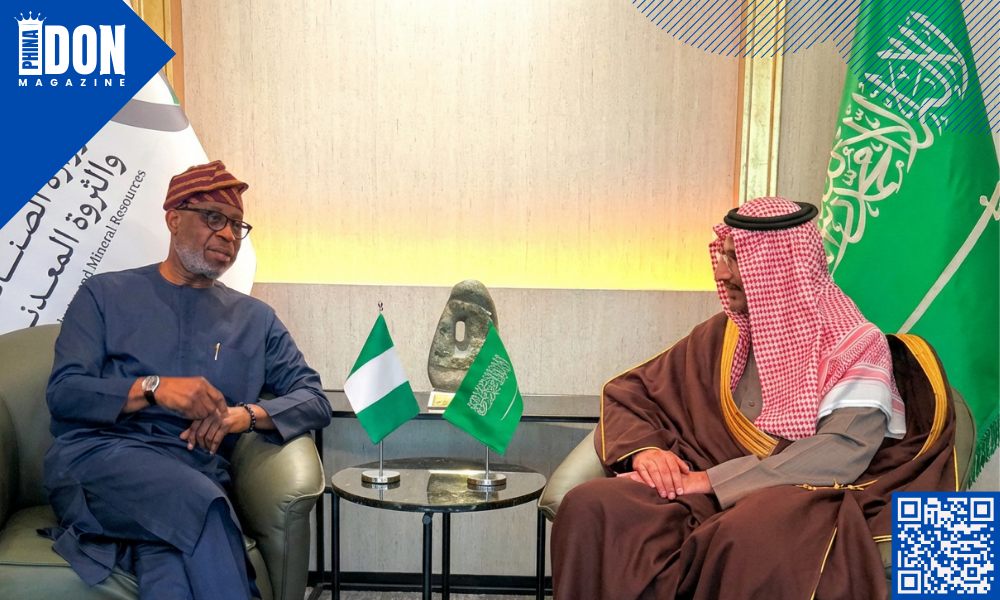
These milestones were unveiled by the Minister of Solid Minerals Development, Dele Alake, during high-level diplomatic talks with the Saudi Arabian Minister of Industry and Mineral Resources, Ibrahim Al-Khorayef. The meeting took place in Riyadh, setting the stage for Nigeria’s participation in the prestigious Future Minerals Forum.
A Shift from Extraction to Industrialization
For decades, Nigeria has been viewed primarily as an exporter of raw natural resources. However, Minister Alake emphasized that the current administration is aggressively enforcing a value-addition policy. This strategy mandates that minerals must be processed locally to boost the economy before export.
“Nigeria’s value-addition policy is already yielding tangible results,” Alake stated. Beyond the operational facility in Lagos, he revealed that three additional gold refineries are currently at various stages of construction across the country. The completion of the lithium processing facility is particularly significant, positioning Nigeria as a key player in the global green energy transition, given lithium’s critical role in battery production.
Strategic Partnership with Saudi Arabia
The Riyadh meeting focused on solidifying a symbiotic relationship between Nigeria and the Kingdom of Saudi Arabia. The discussions centered on technology transfer, exploration expertise, and the training of mining professionals.
Alake highlighted that while Nigeria boasts vast deposits of rare earth elements and critical minerals, Saudi Arabia possesses advanced technical expertise. The goal is to finalize an actionable agreement that goes beyond rhetoric. A joint working group, involving the Saudi Chamber of Commerce, is expected to present a comprehensive report on collaboration frameworks, including mineral traceability and environmental standards.
Boosting Investor Confidence
The Minister stressed that mechanisms for traceability are essential for boosting investor confidence and ensuring ethical mining practices. By enforcing Environmental, Social, and Governance (ESG) standards, Nigeria aims to attract premium global capital.
Responding to the developments, Minister Al-Khorayef reaffirmed the Kingdom’s commitment to the alliance, proposing the drafting of a Memorandum of Understanding (MOU) to be signed during the conference. He urged Nigeria to utilize the forum to showcase its reformed mining sector to Saudi investors, signaling a new dawn for economic diversification in Africa’s largest economy.